
By Scott Burg
Rockman et al Cooperative
What do you think of when you hear the term biomedical engineering?
This is generally not a question most of us expect to be asked during a casual conversation with friends or even strangers. This was, however, the opening question of a recently completed series of interviews conducted by graduate students from Cornell University’s Meinig School of Biomedical Engineering (Cornell BME) and a professional evaluator with families in Ithaca, NewYork and Missoula, Montana to help inform development of the Ithaca Sciencenter’s upcoming Bridges to Bioengineering exhibit. This traveling exhibit is being designed for small to mid-sized museums across the country to increase knowledge and interest in biomedical engineering amongst rural youth 6–12 and their families.
Bridges to Bioengineering is a collaborative project between the Sciencenter, faculty and students from Cornell University’s Meinig School of Biomedical Engineering (Cornell BME), spectrUM Discovery Area/Museum in Missoula, Montana, and Rockman et al Cooperative, a national research and evaluation firm. The project is funded through the National Institutes of Health’s (NIH) Science Education Partnership Award (SEPA) Program.
Museum exhibition design and development is a multi-step, multi-year, iterative process that involves the participation of individuals across different disciplines and backgrounds (e.g., educators, content experts, exhibit developers, artists, evaluators) working together to ensure that the exhibition is impactful, engaging and entertaining for museum visitors. There are a lot of variables to consider when designing museum exhibits, especially science-themed exhibits targeted for younger audiences. An exhibit should promote a child’s understanding of the scientific principle or theme being presented, should aim at presenting abstract concepts in a tangible way, and create a more cohesive ‘story’ so that younger visitors and their families can relate to it in a way which will help them remember the experience over time.
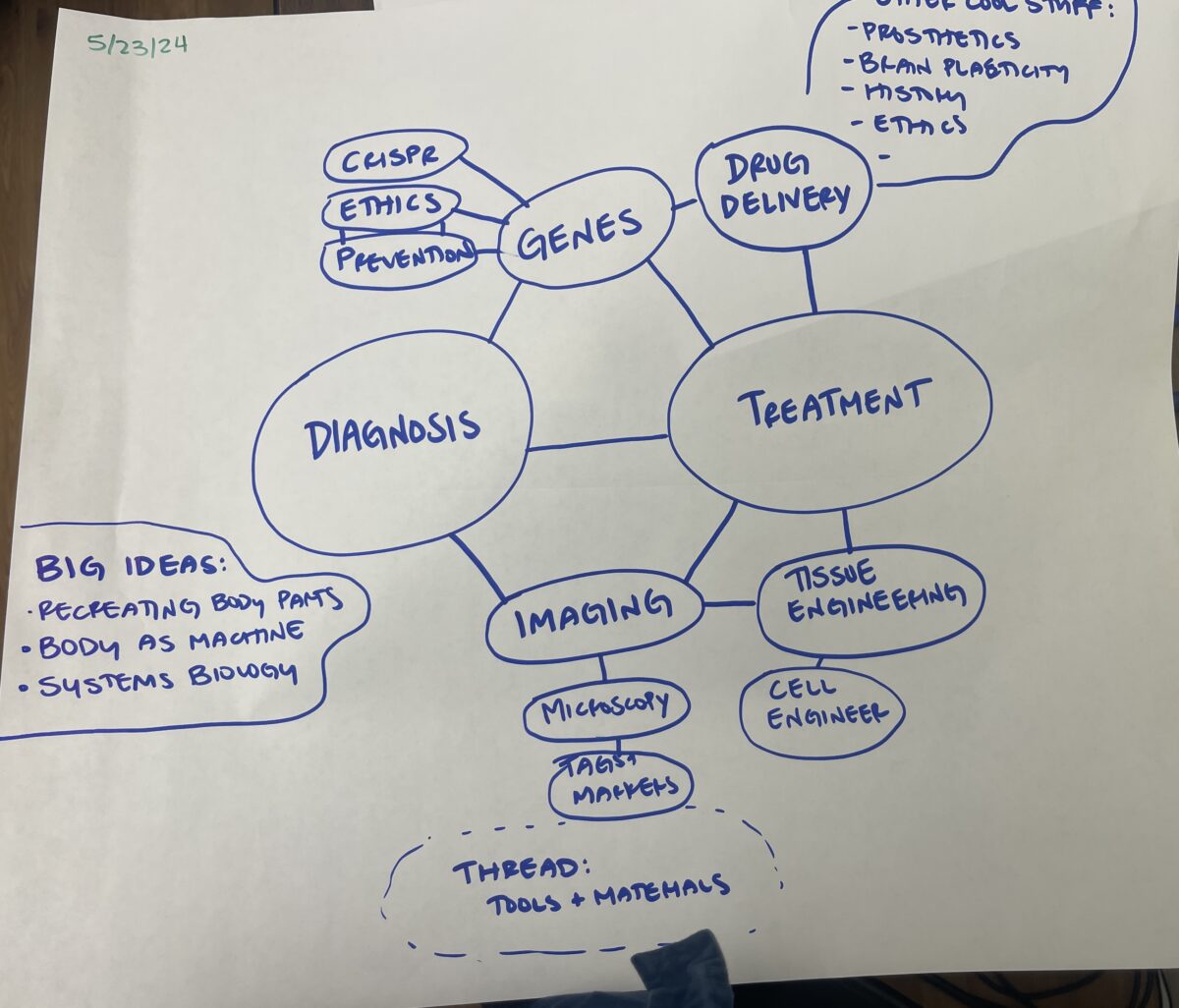
The earliest stages of an exhibit design process involves a lot of brainstorming. What is the exhibition’s ‘big idea’? What are key topics that should be addressed? What are the learning goals? How can key ideas be best communicated to a younger audience? Biomedical engineering (BME) is a complex topic, especially for lay audiences who may not have a foundational understanding of what BME is, the role it plays in medicine and healthcare, and what biomedical engineers actually do.
To shape a narrative and design approach that would be both educational and impactful for this exhibition required the introduction of an innovative co-development model in content expertise, design and science communication. Where traditionally, university researchers and scientists have participated in science museum exhibit development solely as content advisors, Bridges to Bioengineering has involved university researchers and graduate students in all aspects of the creative process — concept design, research, prototyping, and evaluation.
Over a six month period, beginning in Spring 2024, BME graduate students and faculty, along with exhibit designers and educators from Sciencenter and spectrUM have jointly participated in exhibit development brainstorming and evaluation activities. Even though the project is still in the early formative stages, these collaborative sessions have resulted in shared learning amongst the participants. This co-development process has been enriched by the sharing of diverse perspectives and experiences of individuals not initially familiar with each others’ backgrounds or expertise. The involvement of BME graduate students has been a catalyst for thinking about different ways to communicate and present complex science to public audiences.
Working on the NIH BME Sciencenter project has been such a rewarding experience. It has not only deepened my appreciation for the importance of science communication, but it’s also taught me how to tailor complex ideas for different audiences. This work has also influenced how I think about my own research and the role it can play in inspiring curiosity and understanding. — BME graduate student
This was a completely new side to science communication. I think as an engineer and a researcher I’ve only ever previously known science communication to take the form of a written report, or through a scientific publication. I rather naively believed that something like scientific curation or exhibition management was pretty easy if you already knew all there was to know about the topic. But my time with the Sciencenter has really been eye opening in the best ways, and I am beginning to just scratch the surface behind all the thought and work that goes behind actually curating a selection of knowledge and how we can present that information in a way that is exciting and engaging and inspiring for a generation of audiences. — BME graduate student
Front end evaluation
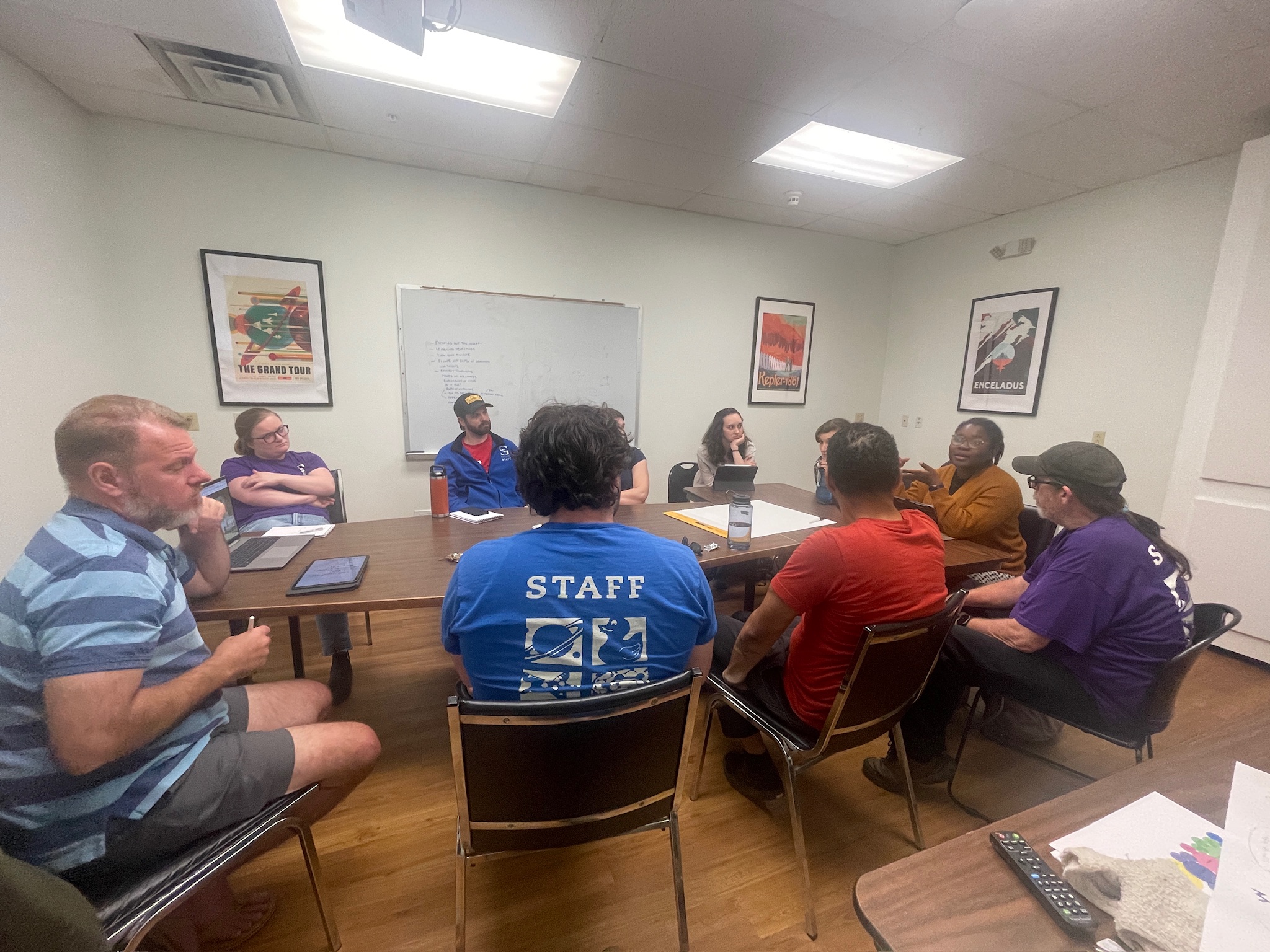
BME graduate students, faculty, and Sciencenter exhibit designers
To aid in the exhibit design process, front end evaluation is an activity that helps the design team to understand what visitors know about a topic, what questions and misconceptions they have, and what content resonates with them personally. Information derived from front end evaluation is incorporated into the materials design and also helps inform and shape the development of exhibit themes and activities. Methods for front-end data collection include surveys and interviews.
Over a 2–3 week period this past summer BME graduate students participated in the front end evaluation process by interviewing parents/caregivers and their young children in the Ithaca, NY area at the Sciencenter and at local science-themed community events, about various aspects of the proposed exhibit. A related front end activity was also conducted in Missoula, MT with adults and children visiting spectrUM. Interviews were also conducted at a local Boys and Girls Club, and at a library community STEM event in nearby Hamilton, MT. Some of the key topics we were interested in knowing more about was:
- What the public knew about BME
- What interested them about BME
- What did they want to know more about?
- What they thought should be included in the exhibit?
- What methods (e.g. media, hands-on activities, etc.) might make the exhibit more engaging and impactful?
- Whether ‘controversial’ BME-related topics such as animal testing, stem cell research, etc. should be included in an exhibit? And if so, how should that information be communicated to children?
Front end evaluation was a very exciting part of this project. Engaging directly with the community, seeing the enthusiasm of people from all ages, and hearing the kinds of questions kids ask has been inspiring. It’s a reminder of just how curious and eager to learn people can be, and it highlights the importance of making science accessible to everyone. — BME graduate student
I think specifically the front end evaluation was such a clear indication to me of what it meant to roll up my sleeves and get on the ground level and actually learn from the audiences I hope to communicate with through the exhibition. I got to learn about my audience’s interests, and I learned what they wanted to see from me. I think it was a great opportunity to involve the audience in the creation of the exhibition, and I can only hope we deliver to their expectations as the exhibition is created. — BME graduate student
Overall, close to 100 individuals were interviewed at sites in New York and Montana. Information from these interviews is being analyzed and will be reported back to the project team later this fall. These front end evaluation findings will help to inform formative prototyping, which is the next stage of the exhibit design process. A new cohort of BME graduate students will be participating in this process that should begin sometime in early 2025.