

Discover the wonder of science alongside your little ones at the Sciencenter! We believe that parents and caregivers play a crucial role as their child’s first teachers. At the Sciencenter, we’ve created programs, resources, and exhibits to make science a part of everyday life for young children (ages 0-4). Our goal is to nurture curious minds and foster a love for STEM wherever they go—whether that’s at the museum, in other public spaces, or at home.

Science Together: Kinetic Sand
Sciencenter offers a variety of programs to promote early childhood learning and development. Our weekly Science Together activities provide the tools and support for parents and caregivers to meaningfully explore science with their kids. The Curiosity Corner, a gallery designed specifically for young learners under 4, offers a safe and playful space to observe, explore, and learn together.
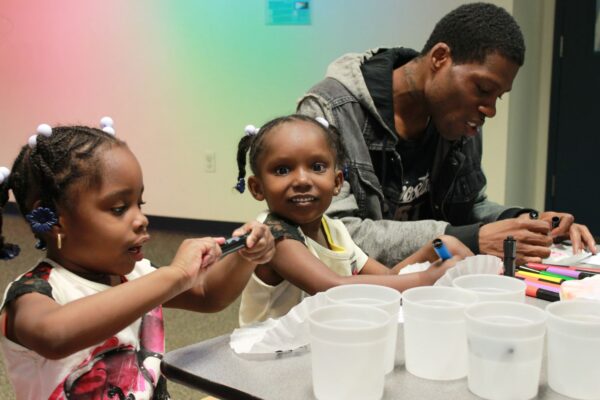
Head Start Family Workshop, 2015
Over the past decade, we’ve also established a rich partnership with Tompkins Community Action (TCAction), the local agency that runs Head Start and Early Head Start programs in Tompkins County. From monthly family science workshops with Head Start families to professional development opportunities for Head Start and Early Head Start classroom teachers, these programs welcome more visitors to the Sciencenter and help us broaden our engagement beyond the walls of the museum.
Michelle Kortenaar, Executive Director, reflects on the early days of this partnership: “In 2012, the Sciencenter established a deep partnership with Head Start and Early Head Start in Tompkins County. Since then, the Sciencenter has promoted our model of collaboration between science and children’s museums and local Head Start programs to foster early science education. This initiative has earned recognition, including a National Leadership Grant from the Institute of Museum and Library Services.”

Science Together: Flower Dissection
In all our work, the Sciencenter focuses on inquiry-based learning, and this really shines through in early childhood science. This approach is child-led and leverages young children’s natural curiosity and experimentation. Our educators focus on questions, problems, or experiments that encourage exploration, observation, and discovery. We help cultivate the skills that scientists and engineers use in their work, while also highlighting the ways young children are already learning about the world around them.
Ali Jackson, Director of Programs and Partnerships, shares her enthusiasm for early science learning: “Young children are little scientists already! We love seeing the delight and wonder on children’s faces as they’re given permission to make a mess and experiment and it’s so critical to provide caregivers with the tools and support they deserve to learn alongside their children and recognize science learning as it’s happening.”

Science Together: Sink or Float
Our Science Together program, held every Tuesday to Friday at 10:30 am, engages children and adults in early childhood science through collaborative exploration. Popular activities include Making Observations with Worms, Using Tools and Ice Melting, and Making Predictions with Sink or Float! We provide the materials and the space and encourage adults to participate with their children in hands-on learning together. Our focus is on the learning process rather than content, so there are no wrong ways to use the materials!
You can also bring the Sciencenter experience home! All activities from Science Together can be replicated at home. Check out our at-home activities at Sciencenter’s resources for home.